
Author – Gillian Meier, Founder & CEO, BlueMagnet
Published – 2025/02/17
How Google’s February 2026 Discover Update Redefines Topical Authority and AI Search

The Google February 2026 Discover Core Update is a specialized algorithmic shift targeting the mobile Google Discover feed. It prioritizes local relevance (content from the user’s own country), topic-specific E-E-A-T (expertise in specific niches), and descriptive headlines over clickbait. While it does not affect traditional keyword rankings, it is a critical signal for appearing in AI Overviews and future predictive search engines.
If your mobile traffic felt like a rollercoaster in early February, you weren’t imagining it. While the digital marketing world was still dissecting the massive December 2025 Broad Core Update, Google quietly flipped the switch on a new, highly specialized algorithm change: the February 2026 Discover Core Update.
At BlueMagnet, we’ve spent the last decade watching these cycles. However, 2026 is already proving to be a watershed year following the 2025 search strategy shifts we’ve already seen. We are moving away from the era of “General SEO” and moving towards Entity-Based Predictive Search.
This article breaks down exactly what is happening right now, how it connects to the turbulence of December, and how these shifts are the necessary precursors to surviving the era of AI Overviews (AIO) and the broader AI Search Engine landscape.
Decoding the February 2026 Discover Core Update
On February 5, 2026, Google began the rollout of a targeted update for the Discover Feed. Unlike a “Broad Core Update,” which re-evaluates the entire index for traditional search queries, this is a Specialized Core Update. It doesn’t care about what people type; it cares about what people crave.
The Three Pillars of the February Update
A. Hyper-Local Prioritization
Google has intensified its “proximity of relevance.” The algorithm now prioritizes content from publishers located in the same geographic region as the user. This is a massive blow to international “content farms” that produce generic English content to capture global ad revenue. If you are a South African brand, you are now more likely to dominate the feeds of South Africans, but you face a steeper climb to reach users in London or New York unless your content is globally unique.
B. The “Topical E-E-A-T” Granularity
In February 2026, Google moved the goalposts on trust. They are now applying E-E-A-T (Experience, Expertise, Authoritativeness, and Trustworthiness) on a per-topic basis. If your site is a powerhouse in “Renewable Energy” but you decide to write a “Best Skincare for 2026” article, Google’s Discover engine will likely suppress it. It no longer trusts your brand’s voice outside of its proven, historical niche.
C. The Death of the “Curiosity Gap” (Anti-Clickbait)
The “Anti-Clickbait” filter is no longer a suggestion; it is a penalty. Google’s natural language processing (NLP) models have become adept at identifying headlines that withhold the “core value” of the article to force a click. Google wants a “no-surprise” user experience where the headline tells the full story.
The lesson from this Discover update is not to chase another algorithm. It is to become clearer about what your organisation genuinely knows, where it has evidence and experience, and how consistently that expertise is reflected across your content. Those are much more sustainable signals than trying to reverse-engineer individual Search features.” Gillian Meier, CEO, BlueMagnet

Connecting December 2025 to February 2026
To understand the “Why” of February, we must look at the December 2025 Broad Core Update.
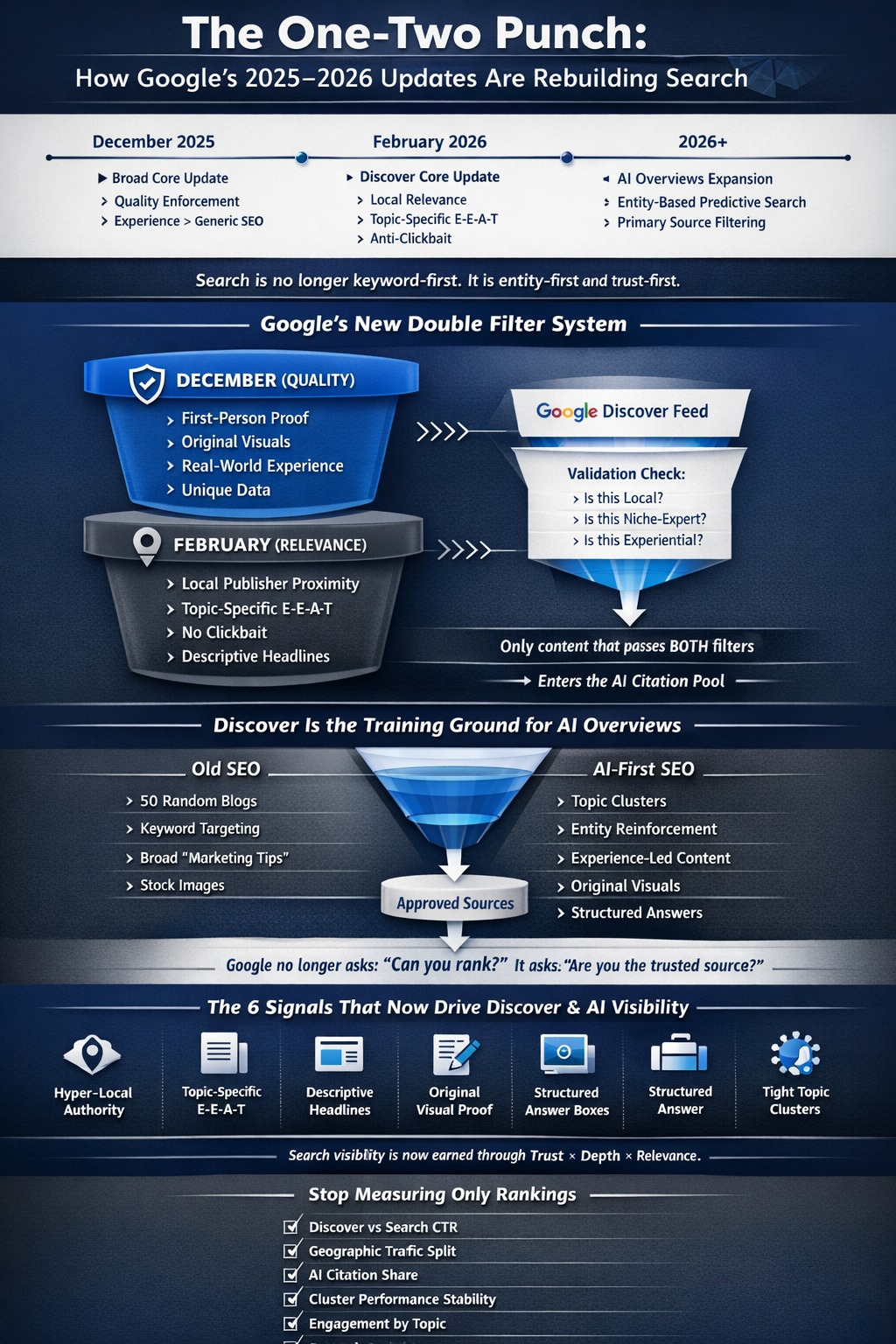
December was an “Index-Wide Quality Enforcement” event. It targeted “SEO-first” content pages built solely to satisfy a keyword. It introduced a higher weighting for the first “E” in E-E-A-T: Experience. It rewarded content that provided “First-Person Proof” original photos, unique data sets, and narrative voices that couldn’t be easily replicated by an LLM (Large Language Model).
The Strategic Connection
Think of the December update as the Foundation and February as the Delivery.
December ensured that only high-quality, experiential content survived in the index.
February ensures that this high-quality content is delivered to the right local user at the right time in their personal feed.
If you were hit in December, your site likely had a “quality” problem. If you are being hit now in February, you likely have a “relevance” or “authority-narrowing” problem. At BlueMagnet, we view these as a one-two punch designed to clear the deck for AI-driven search.
Discover as the Training Ground for AI Overviews
The most critical insight we can offer is this: Google Discover is the laboratory for Google’s AI Overviews.
When AI generates an “Overview” at the top of a search result, it pulls from a “vetted pool” of sources. The February Discover Update is essentially a filtering mechanism to determine which sites are trustworthy enough to be cited in an AI-generated answer.
How it works:
- Validation: The algorithm checks if the publisher is a local expert (the February update’s focus).
- Citation: If the site passes these checks, it is indexed as a “Primary Source” for AI Overviews and Search Generative Experience (SGE).
If content is disappearing from Discover because it is deemed “generic,” it is effectively being blacklisted from the future of AI Search.
Who Is Most Affected?
The Google February 2026 Discover Core Update is highly relevant to anyone generating content, not just traditional news publishers. While it significantly impacts large-scale news and content-led sites, it also directly affects niche blogs, individual content creators, and small business websites that appear in the Discover feed.
- Content Creators & Bloggers: The update prioritizes topic-specific expertise, meaning niche bloggers who consistently produce in-depth, original content in a specific subject area stand to gain visibility.
• Business Websites with Blogs: If your company blog provides timely, expert insights that offer real value rather than generic, keyword-stuffed advice, you are more likely to be surfaced.
• Localized Publishers: Because the update heavily favors geographic relevance, local businesses and regionally focused blogs now have an advantage in reaching users within their own country.
Key Takeaway for All Content Owners
If your goal is to appear in the personalized Discover feed, the algorithm now evaluates your content based on trust and depth rather than broad site authority. This makes the update a “tailwind” for specialized creators who prioritize original reporting and expert-driven value.
Adjusting Your SEO Action Plan
1. Audit Your “Entity” Footprint
Google does not just see a URL; it sees it as an “Entity.” Strengthen your digital signals:
- Update Google Publisher Center with accurate geographic data.
• Ensure Schema.org markup is robust, specifically using author, reviewedBy, and areaServed tags.
• Social Signal Synchronization: Ensure your LinkedIn and other professional profiles clearly define your “Topic E-E-A-T” to reinforce your entity’s authority in Google’s Knowledge Graph.
2. Pivot to “Descriptive Value” Headlines
The editorial team must move from “Tease” to “Promise” to survive the “Anti-Clickbait” filter.
- Old Strategy: “The Secret Ingredient to SEO Success in 2026.”
• New Strategy: “Why Topic-Specific E-E-A-T is the Primary Driver for 2026 SEO Success.”
• The “Rule of Context”: Ensure the headline identifies the who, what, and why immediately, as this transparency is a key trust signal for both users and AI Overviews.
3. Technical Visual Integrity
Discover is a visual-first medium; low-res images will be skipped by the algorithm.
- High-Res Standard: Ensure all featured images are at least 1200px wide and use the max-image-preview: large tag.
• First-Person Visuals: Avoid stock photography. Use original, high-quality photos or unique data visualisations to provide the “First-person proof” Google now demands.
• Alt-Text as Context: Use descriptive Alt-Text that reinforces your “Topic Clusters,” helping AI “see” the relevance of your media.
4. Build Granular “Topical Authority” Clusters
The February update applies E-E-A-T on a per-topic basis. You cannot be a “generalist” anymore.
- Deep-Dive Silos: Group your content into tightly themed “Topic Clusters.” Instead of 10 random blogs, create 10 interlinked articles that cover every angle of a specific niche.
• Internal Link Strategy: Use descriptive anchor text to show Google exactly where your expertise begins and ends within a cluster.
• AI Readiness: Comprehensive clusters provide the dense information AI Engines need to synthesize “Primary Source” answers.
5. Prioritize “Experience-Led” Content (The December Carryover)
The foundation of the February delivery is the quality established in December.
- “I” over “They”: Use first-person language to describe case studies, tests, and real-world results.
• Unique Data Points: Incorporate proprietary data or insights that an LLM (Large Language Model) cannot scrape from the general web.
• Expert Byline Citations: Link author bylines to dedicated bio pages that list specific certifications, years of experience, and previous authoritative works in that niche.
6. Optimize for “Visual Citation” and AI Synthesis
Position your content to be the “Primary Source” for AI Overviews.
• Direct Answer Formatting: Include a clear, 40–60-word “Answer Box” at the top of long-form content to make it easily digestible for AI crawlers.
• Structured Lists and Tables: Use HTML tables and bulleted lists for complex data; AI models prioritize these structured formats for “Featured Snippets” and AI Overview citations.
• Citation-Friendly Headers: Use H2 and H3 tags that mimic the natural language questions users ask in AI search engines.
Key Metrics: What to Compare and Check
To fully capture the “One-Two Punch” of the December (Quality) and February (Relevance) updates, we need to look beyond surface-level traffic. Because these updates are the “laboratory” for AI Overviews, your metrics must now measure trust and topical authority as much as they measure clicks.
1. AI Attribution & Citation Share
- The Metric: Compare the number of unlinked mentions versus AI citations in tools like Search Console or third-party AI tracking platforms.
• The Focus: If your December “Experience” signals (original photos/data) were strong, you should see an increase in your content being synthesized in AI answers, even if direct Discover clicks fluctuate.
• AI Link: Google’s AI models prioritize the “First-Person Proof” rewarded in December to validate the “Local Expertise” prioritized in February.
2. Topical Cluster Stability (The “Niche Authority” Test)
- The Metric: Segment your Google Search Console data by Content Cluster (e.g., “Technical SEO” vs. “General Marketing”).
• The Focus: Identify if one specific cluster saw a lift while others remained flat or dropped. If “Cluster A” is surging in Discover, that is the “Entity” Google has flagged as your primary area of expertise.
• AI Link: AI Engines (like Perplexity or Google’s AIO) are less likely to cite a “generalist” site. They prefer a “niche master” for specific queries.
3. Image Engagement & “Visual Quality” Score
- The Metric: Compare the CTR of articles with custom original photography versus those using stock imagery.
• The Focus: Based on the December update’s push for “First-Person Proof,” articles using 1200px+ original, high-res images (as noted in your checklist) should significantly outperform stock-heavy pages.
• AI Link: Google’s “Multimodal” AI capabilities mean the engine “sees” your images to verify if you’ve actually experienced the topic you’re writing about. Original visuals are the ultimate “Proof of Human” signal.
Checklist for Your SEO Report
- Discover vs. Search CTR (Clickbait/Headline Check)
- Geographic Traffic Split (Local Relevance Check)
- Engagement Time by Category (Topical Trust Check)
- AI Citation Rate (AIO/Predictive Search Readiness)
- Cluster Performance Variance (Niche Authority Check)
- Original Media CTR (Visual E-E-A-T Check)
Why Google is Future-Proofing Search
Google is fighting “The War of Information Density.” With the flood of AI-generated “slop,” Google must enforce Local Relevance and Narrow Expertise to create a “Proof of Human” filter. An AI can write a generic article about “Saving Money,” but it cannot provide a hyper-local report on local tax changes. Future-proofing your brand means becoming unreplaceable by AI.
The Age of “Generalist Content” is over
Google is asking: What are you actually an expert in, and why should a local user trust you?
Are you seeing a dip in your February traffic? Don’t wait for the March data to realize you’ve fallen behind. Schedule a strategy consultation with BlueMagnet to perform a deep-dive audit of your E-E-A-T signals and Discover readiness.
Frequently Asked Questions (FAQs)
No. This update specifically targets the Discover feed, which is primarily a mobile experience. However, the signals it uses (E-E-A-T and local relevance) are highly correlated with how your site will eventually perform in AI Overviews on all devices.
Google officially stated the rollout began on February 5, 2026, and will take approximately two weeks to complete. We recommend waiting until after February 19 to perform a final data analysis.
Not necessarily. Core updates are often “re-weighting” events. Google may simply have found another local or more specialized source that it believes is a better fit for the user’s current interests.
Yes. Unlike traditional search penalties, Discover is very sensitive to real-time signals. Adjusting your headlines to be more descriptive and less sensational can lead to a relatively quick recovery in the feed.
While this is a Google update, the shift toward “Primary Source” authority is universal. AI engines prioritize sites with clear author expertise and original data. By optimizing for Google’s February update, you are inherently making your content more “citable” for all AI search engines.


